

Today, the Hechinger Report published a an analysis of how much students from homes with family income under $30,000 a year would have to pay to attend their state's flagship university.
The news is not good.
... in 34 states, it costs students from low-income families at least a third of their household income — upwards of $10,000 a year — to attend the state flagship university. That includes not just tuition, but also room and board and books, after accounting for all grants and scholarships — what’s known as “net price.”
Nearly 1 in 6 households in the U.S. is below that $30,000/year income level.
Meredith Kolodner, the author of this analysis, notes that while the costs of college have dropped in recent years, wages have not kept up with inflation as families now pay more for food, housing, or medical care.
Students from family incomes from $30,000-$48,000 must also pay substantial amounts of their entire household income for college, as graphically represented in one of Kolodner's maps:
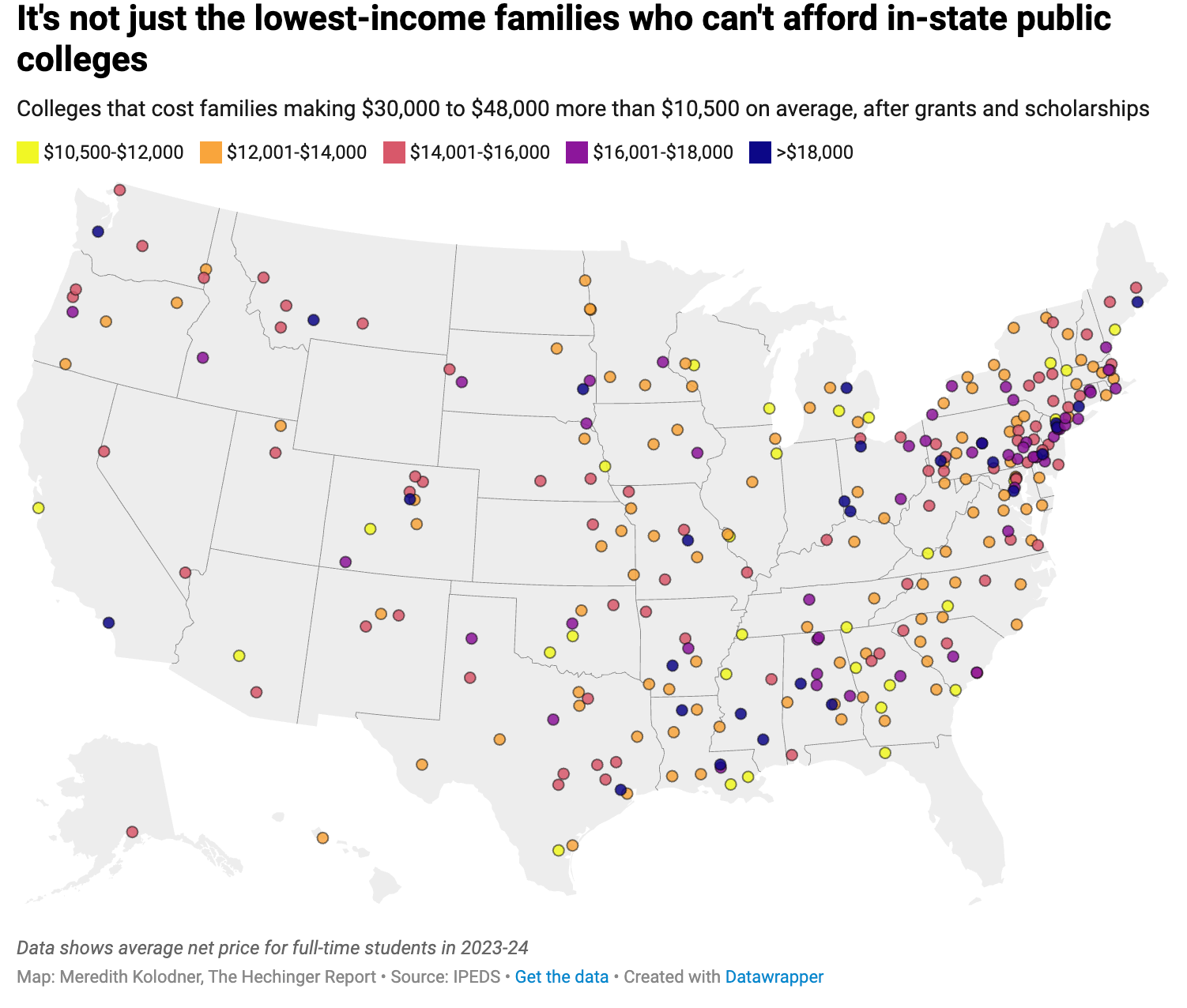
The wide range of costs for attending state colleges is a powerful reminder that college costs are policy decisions. States decide how much of the cost of attending college will be paid by the legislature and how much will come from tuition. States decide how much state financial aid will be available for lower-income students, above and beyond federal aid.
Students from families who make less than $30,000 paid just over $1,000 out of pocket for tuition and other costs at the University of Michigan and roughly $2,000 at the state flagships in Florida, North Carolina and Illinois. Pennsylvania State University and the University of Alabama were the most expensive for low-income families, but the state flagships in New Hampshire, New Jersey, Oregon and Iowa all also cost students whose families make less than $30,000 more than half their annual income.
Only an informed public can advocate for affordable college, regardless of the politics of their state and regardless of household income.
Meanwhile, most colleges fall far short of educating students about the inequalities of college funding and about how collective voices might demand change.
And once again, from my soapbox: every first-generation student should know about the political decisions that shape their financial struggles and about how citizens and their elected representatives in different states make very different choices about access and opportunity in higher education.
Toward that end, this would be a great article to add to my fantasy syllabus for a first-year course that every student would take. Just after first-year orientation where students are encouraged to dream big about their potential, we'd start the conversation about why the costs of big dreams are so much higher in some states than in others, and so much higher than they were a few generations ago.


