

I'm thinking a lot about who will be at the table as we move forward in our public and political life in the U.S. I have to keep thinking about how we rebuild K-12 and colleges for equity and opportunity. And thus, I keep thinking about who will be at the table when those conversations happen.
For years, people in the pipeline for political, economic, cultural, and scientific leadership have been first screened by admissions teams at elite colleges and universities. And those admissions teams continue to overwhelming admit the children of the most elite people in the country.
That pattern is documented once again in a new report from Class Action on the very limited admission of students eligible for Pell Grants on these elite campuses. Pell grants have been the backbone of federal financial aid since the 1965 Higher Education Act attempted to open opportunity for students from low and moderate income families. Then, Pell Grants covered up to 80% of the costs of college. Most recently the grants cover only 31% of the costs of college but remain one of the few federal tools that address college affordability for poor and working-class students other than subsidized loans.
Documenting the number of Pell-eligible students admitted at elite colleges is one measure of predicting how likely it may be to have people from poor and working-class backgrounds at the table as we rebuild a more just and caring democracy and more equitable schools.
The news is not good. The entire Class Action report is eye-opening but this chart stopped me in my tracks:
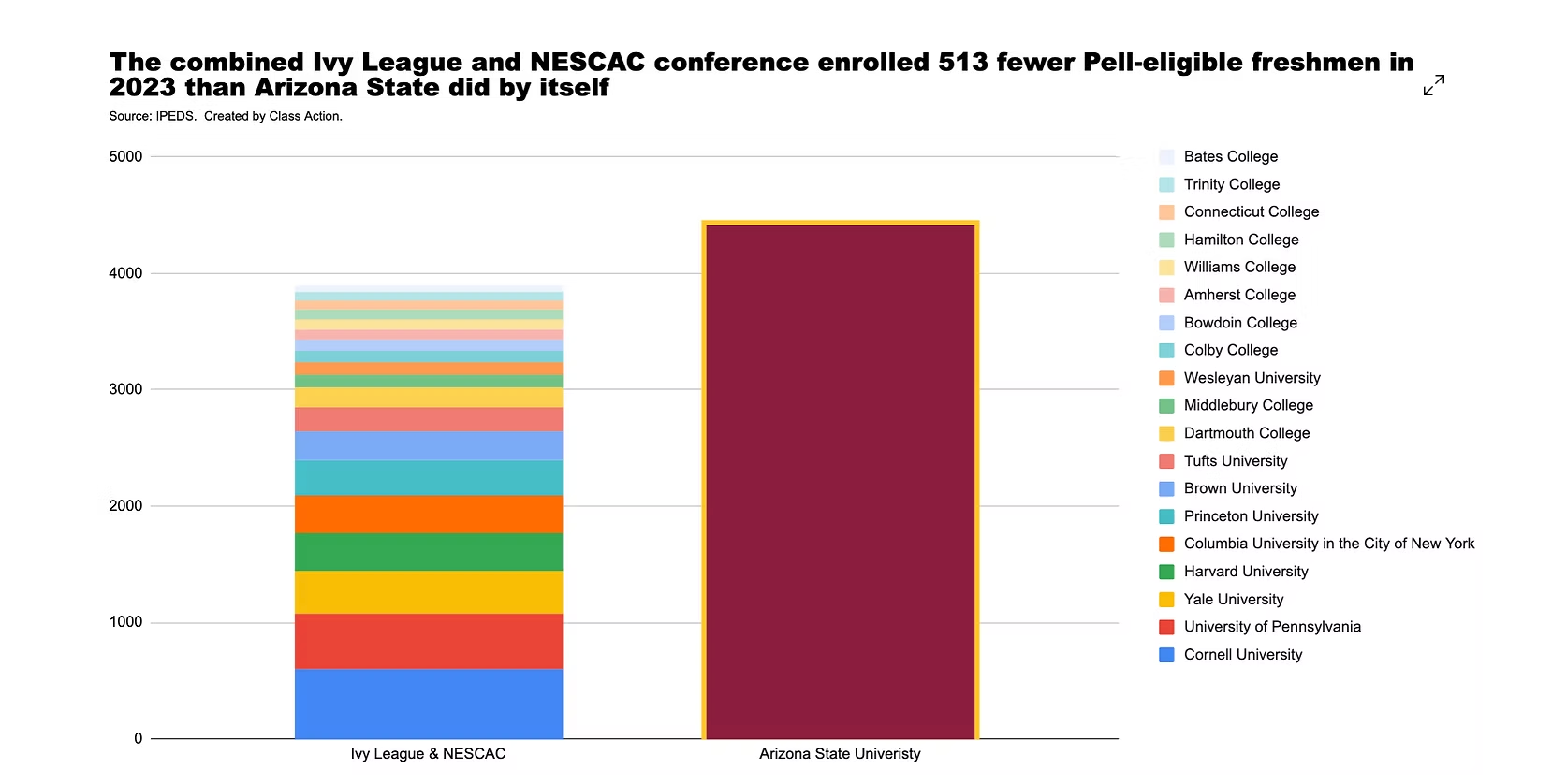
The column on the left represents the cumulative Pell grant eligible first-year students at the 19 elite campuses of the Ivy League and the campuses of the New England Small Schools Conference. The column on the right is the number of Pell grant eligible first-year at a single public college: The Arizona State University.
Elite Education, the Right and the Left
It's tempting (for me anyway) to assume that excluding poor and working-class people from pipelines to power is an artifact of conservative politics. They are the ones who pontificate about "merit", assuming that those admitted to these schools are simply reaping the rewards of being the smartest, hardest working, and most moral individuals among us. The disproportional hiring of these graduates into the best firms and journalism and academic positions, their nomination for judgeships and election as Senators only confirm the unique talent and hard work of these privileged people. So they argue.
The Left theoretically acts on entirely different beliefs: That a leadership path through the competitive admissions screening of elite colleges is inevitably a mechanism for sustaining structural inequality. Denying admissions to poor-and working-class students should be understood as opportunity hoarding among those in power to protect their own interests. The system normalizes growing economic inequality, the Left argues, as these admissions pipelines credential privileged people as inherently more deserving than everyone else.
As Leftist groups such as Class Action and Opportunity Insights work to reform college admissions we might at least expect to see Leftist circles hiring from outside those elite campuses to create more equitable pathways to leadership. The "pipelines" though these colleges only work if hiring draws disproportionately these colleges. Surely, those in power on the Left would seek broader forms of "merit" in hiring than whatever qualities are valued by admissions offices at Harvard or Bates. Surely, the leadership of the Left doesn't act as though the smartest and most hardworking and moral among us actually were first identified by those admissions offices?
We might hope.
I often do quick searches of the names I see speaking on behalf of of Leftist visions of equity and justice. As I as look at who is editing and writing for Leftist publications, who has the biggest audiences among Leftist political podcasters and freelancers, who founded (and then controls hiring for) leftist advocacy movements like the Sunrise Movement or the Justice Democrats, who is hired for the campaign and congressional office staff of progressive members of congress, (and many of those progressive members of congress themselves), I see the same thing over and over.
The very small number graduates of elite private colleges are considerably over-represented within the leadership of the Left. Even the Center for Working Class Politics is staffed overwhelming by graduates of elite, private, exclusive colleges. *
I understand that those graduating from a very elite college and then working for justice are very different from those who just continue on to Wall Street.
Yet that distinction fades if both groups believe what they heard at their first-year campus orientation about why they were admitted: You are destined for leadership because you are the best and brightest. You will enjoy enviable privileges here as would be fitting for people like you who will contribute so much to the world.
And obviously, others not admitted are destined to be your followers.
As We Rebuild
We can't go back to an educational system that reproduced rather than diminished inequalities. We can't go back to systems that left too many brilliant and hardworking poor and working-class students questioning whether they even deserve a place at the table.
I know exactly how the Right will continue to justify elevating elite voices and excluding everyone else from educational policymaking.
I have no idea how leaders of Leftist political spaces justify their own forms of social class exclusion within circles of power. I want to imagine now having open and frank reckoning with why Leftist leaders so often trust the admissions office at the small number of elitist colleges to screen who will get a voice within their circles.
In Teaching to Transgress, bell hooks envisioned educational spaces
in which poor and working-class students are visible and vocal as they address the questions of their lives, and where the ideas and experiences of the privileged are routinely examined and criticized.
I don't think that we can build something better than the educational systems now being dismantled unless hook's vision also describes new policy making spaces.
If it's hard for any of us to imagine that people from poor and working-class backgrounds would actually lead this work instead of trusting the graduates of Harvard and Bates to speak for them, that may be just one measure of how deeply the myths of meritocracy have permeated our understanding of voice and democracy, even on the Left.
*Of course some of those in leftist power may have been among the rare Pell Grant eligible students admitted to prestigious schools. That would still beg the question about why they, and not their peers a few places below the cut on the admissions list (who wound up at a state schools) get the jobs.


