

It's easy to assume that our highly stratified system of higher education has always existed, that high achieving students were always sent to elite institutions where the grass is always green and the classrooms always gleaming, and small groups of students bask in the attention of faculty in small seminar rooms. It's easy to assume that students on those campuses have earned those privileges by being smarter than everyone else, because they are likely to accomplish so much after college.
Yet as Zachary Bleemer and Jesse Rothstein show in their new working paper, early proponents of college enrollment advocated for open admissions everywhere: Any student who had completed a preparatory course of study in high school could enroll anywhere. Some campuses began admissions testing to screen out unqualified applicants, and many students never graduated, but tuition remained relatively low and admissions relatively open.
Then, as demand for college degrees grew after World War II and state and federal budgets invested more in higher education, public policy shifted to narratives about "merit": Only the highest achieving students would attend the most elite campuses with their small classes, star faculty, and state-of-art facilities. Utilitarian new public colleges would be built for everyone else.
And, then, once the highest achieving students were concentrated on select campuses, those campuses would invest even more in their education. More people might be allowed to get degrees, but much more would be invested in the education of the elite.
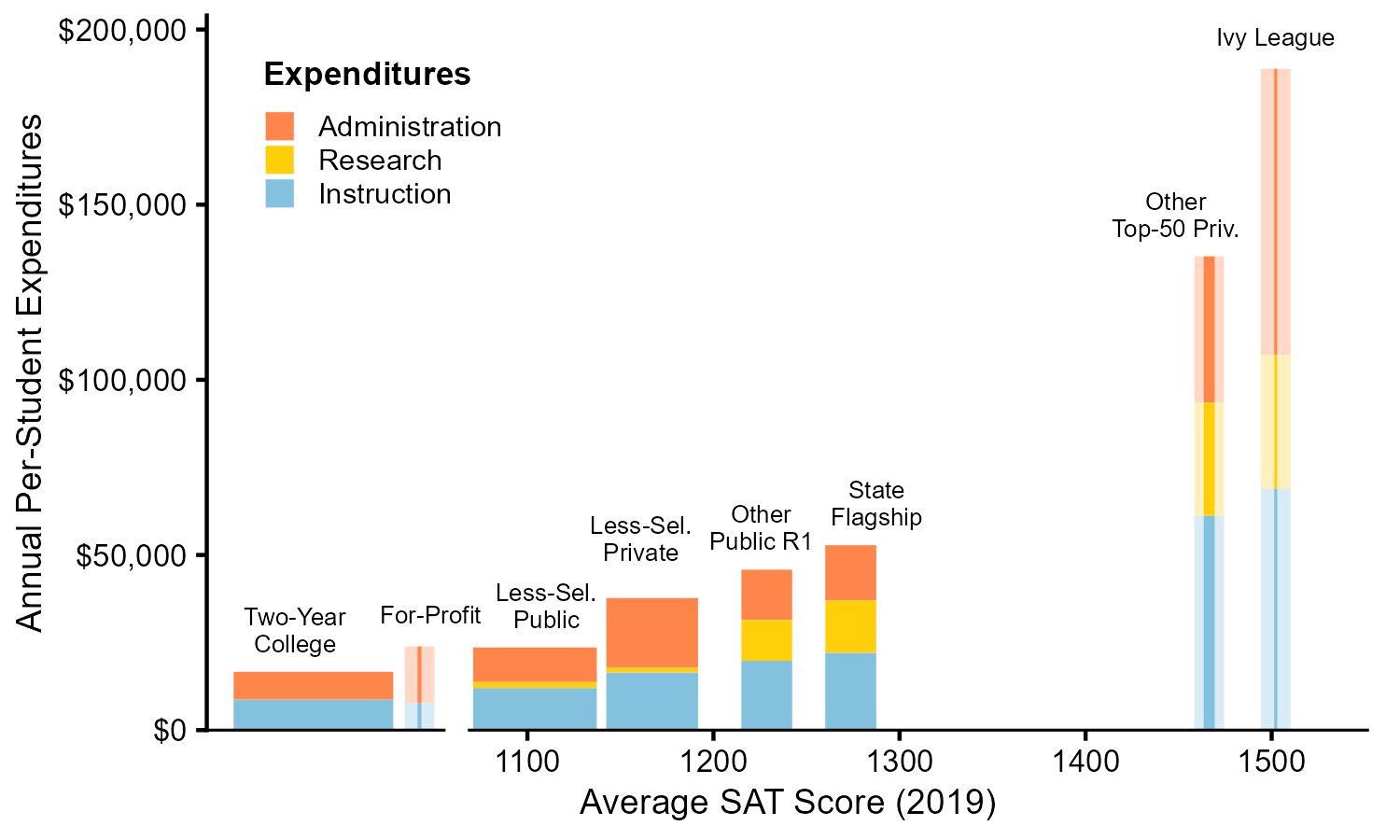
As late as 1960, most US higher education institutions remained effectively open-access and variation in per-student expenditures was relatively low. Since 1960, stratification has steadily intensified. In 1969, the top quarter of institutions by selectivity (enrolling the highest-testing students) had per-student instructional expenditures about double those at the institutions in the bottom quarter of test scores. By 1993, this had risen to about 2.5 times, and by 2019 to three times.
Bleemer and Rothstein's graphics make the contrasts vivid:
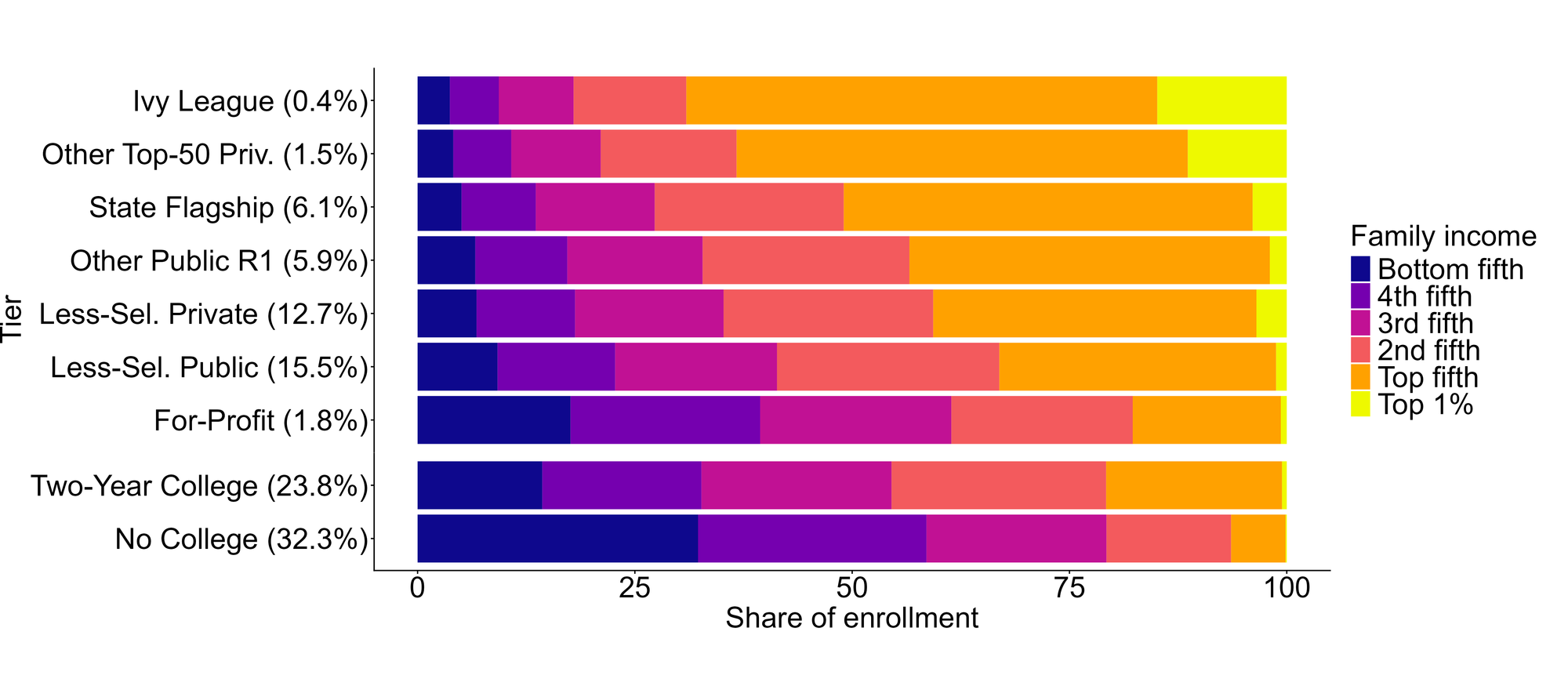
And as we know, those high achievers were overwhelmingly from the highest income households. Campuses would bestow much more on students from the wealthiest families who had attended high-resourced high schools and grew up in resource-rich communities than other campuses could invest in their students.
Then, as (large) gaps in resources between campuses leveled off, privileged students began to benefit from new internal inequalities in resource allocation.
In the 60's, students could enroll in any major they chose. Now, with increased demand for majors leading to the highest-paying careers, students must apply again for admission to majors, and high-achieving students from high-resource communities are most likely to be admitted to the majors that are the most expensive for campuses to offer, though these students pay the same tuition as everyone else.
More colleges also now offer honors programs, and high-achieving students in those programs benefit from smaller classes, more personalized advising, and extra co-curricular opportunities while paying the same as other students.
Bleemer and Rothstein find little evidence in the literature for any arguments that these inequalities are efficient. The find little empirical support for arguments that higher investments in higher achieving students generates public good, little evidence that highly competitive admissions to elite programs motivate high school students to work harder, no evidence that students in non-elite colleges couldn't also benefit from more generous investments in their education.
All of this inequality in higher education has instead been a policy choice that benefits the children of those in power.
Colleges and universities in the United States are highly stratified by students’ pre-college academic achievement, with the highest-achieving students attending colleges that spend dramatically more on instruction than those that lower-achieving students attend. Neither of these is a necessary feature of a higher education market; universities need not be as stratified by academic achievement as they are in the United States, nor do resources need to be so inequitably distributed. There is little economic evidence justifying the status quo on efficiency grounds, and substantial room for skepticism.
Matt Barnum's summary of the study in Chalkbeat succinctly drives home the point:
The result is that American higher education widens the inequality of opportunity that begins in childhood. This system is not simply the result of free choices in a free market; it is supported, subsidized, and, in the case of public universities, created by the government.
And studies like this are why I believe so strongly in teaching explicitly about social class inequalities across the curriculum and in mentoring poor and working-class students in analyzing power that works against them.
Because simply assuming that wealthy students deserve so many more resources than the vast majority of students – in kindergarten or in college – does not serve any of us well.


