

I was just mindlessly scrolling in line at the hardware store when I learned about admissions readers penalizing low-income students more often for using AI/Large Language Models (LLMs) when they write college admissions essays. This post would have stopped me in my tracks had the line actually been moving:
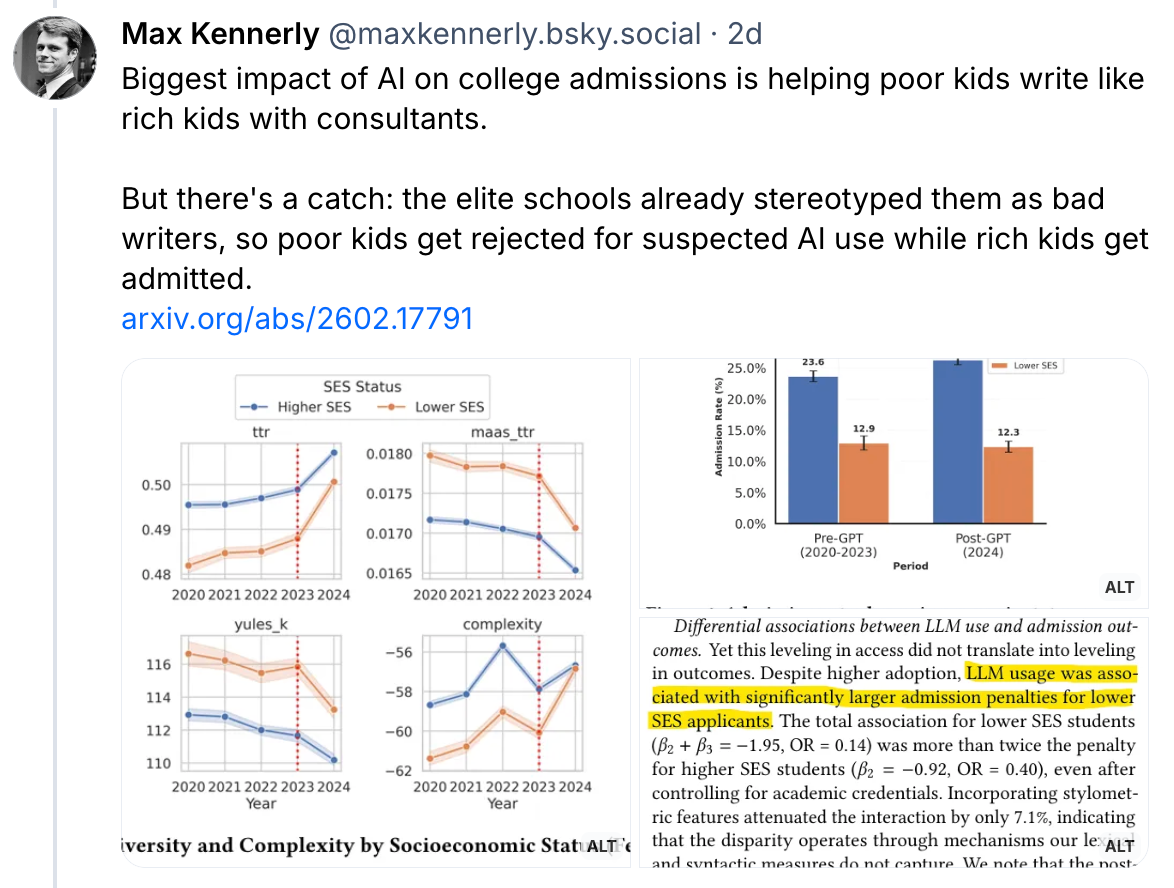
I tracked down the (open access) article when I got home, and it's fascinating research that (of course) gets to even more nuance than the post that jumped out of my feed that morning. Essentially:
- Apparent use of AI while writing admissions essays rose sharply in recent years among high socio-economic status and low socio-economic status students, with use increasing more among low SES students. Given that higher SES students have long had more access to formal and informal coaching and editing for their essays, the authors argue that this higher rate of AI assistance among lower-income students might be expected:
Higher adoption among lower SES applicants represents a rational response to resource constraints, a form of technological leveling the digital divide literature has long anticipated.
- While many high SES students have long employed coaches and editors to craft their essays, AI seems to have given some low SES students a new form of feedback or "coaching" on their essays. With increased use of AI across the board that also tended to standardize the writing of higher SES students, lower SES students are submitting essays written in linguistic styles much closer to those of more privileged students.
BUT:
- It appeared that high SES students using AI were using more sophisticated prompts when writing their essays because they had access to educational resources for learning how to use AI. Lower SES students figuring out AI on their own may have lost both voice and "authenticity" when seeking technological help in writing more linguistically complex essays. They may also have left more detectable traces of AI use in essays, while higher SES students had learned to polish AI output.
- In the end, though differences in linguistic styles between higher and lower SES students were significantly reduced with higher AI use, admissions rates for lower SES students declined slightly after widespread use of AI in preparing admissions essays. There was no improvement in outcome though essays were now linguistically very similar.
- One reason for this decline in admissions: Controlling for GPA, test scores, and other factors in the admissions file, low-income students whose essay suggested "intensive" AI students were twice as likely to be denied admission than high-income students who also had indicators of "intensive" AI use in essay preparation.
So, lower SES students may have been less-skilled in their use of AI for writing "authentically". They may have left more apparent traces of AI "help" in writing the essay.
AND:
The authors also correctly note that essays are not read in isolation. They're read in the context of all of the other information in the application. And thus:
Additionally, admissions readers may interpret polished writing with greater suspicion when it appears inconsistent with other aspects of a lower SES applicant’s profile. LLMs may also reproduce linguistic norms associated with privilege, generating text that reads as performatively sophisticated without the narrative specificity readers associate with genuine voice. {footnote numbers removed for clarity}
That mismatch between the kind of writing that a reviewer may expect of low SES students and the "polished writing" that students created with the help of AI/LLM may have been the nudge for readers to look more critically at these applications.
And, admissions readers then rejected the applications of lower-income students at higher rates than they rejected higher-income students whose essays also suggested "intensive" use AI when scrutinized by the researchers.
There are no technological magic bullets to solve the structural inequalities that leave lower-SES students with fewer college counselors and less access to information about what college admissions reviewers look for.
The authors thus do not settle for recommending that someone coach lower-income students about more sophisticated ways to use AI. They write instead that now that AI is used so extensively, we need much deeper understanding of "how AI tools interact with existing systems of educational stratification and to inform more equitable evaluation practices".
In the end, it comes down to the fairness of human decision-making, not just access to technology.
As a commenter on the post sarcastically wrote:
There's a right way and a wrong way to do things. The wrong way is to use AI to write your essay. The right way is to hire an ex-admissions officer at one of these schools to rewrite your essay, or if you don't have that kind of money, a recent graduate.
They're just enforcing academic standards!
But as this research suggests, privileged students also using AI the "wrong way" are penalized less often when they can access resources to learn more sophisticated ways to hide traces of inappropriate use.
And, privileged students are penalized less often even when doing it "wrong" when admissions counselors actively look for red flags in the applications of low-income students.
This study was based on review of 81,663 applications to one selective university between 2020 and 2024. I can think of a dozen studies to take this analysis even further on campuses across the country. Surely, someone reading this knows of graduate students who would love to dig deeper?


