

I've spent a lot of time in the past few weeks listening to political discourse about social class. There has been yet another news cycle of wealthy [male] consultants recruiting someone that they believed would appeal to [male] working-class voters, and then wealthy [mostly male] media figures were paid to analyze what happened when that campaign imploded.
It sometimes felt within the chaos as if informed discourse about social class and power --already so muddled – was set back decades.
So I returned to Daniel Laurison's recent research on lower voting participation rates among low-income voters, because in Laurison's work, people in poor and working-class communities are trusted to speak for themselves.
Laurison's HEARD (Healthy, Equitable, and Responsive Democracy) Center at Swarthmore conducted in-depth interviews with 144 diverse non-voting low-income people in Pennsylvania and we do well to listen to what these people say.
From Laurison:
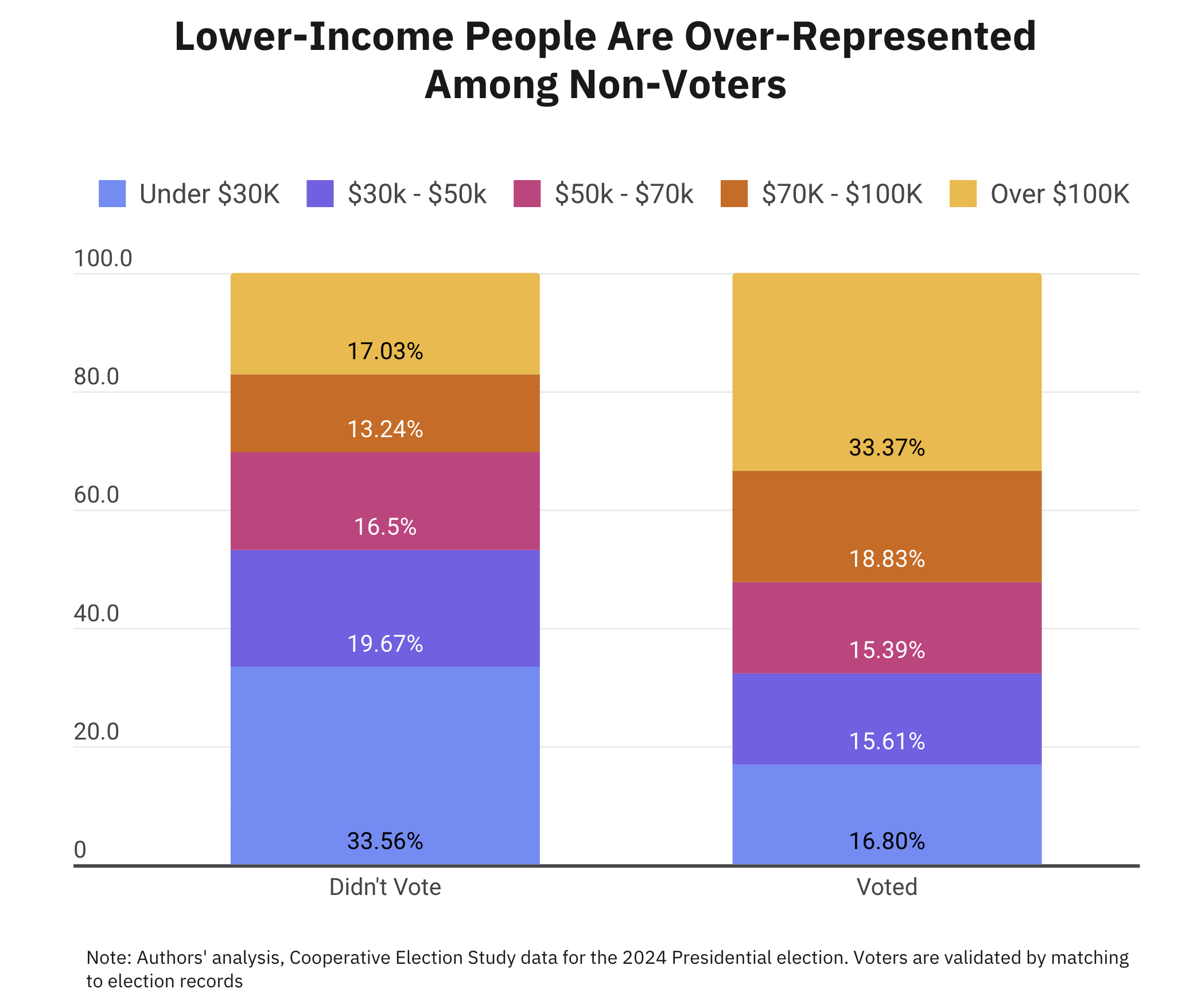
The people in Laurison's study care deeply about their communities and could identify specific issues that are affected by politics. They did not see political decisions that made their lives better. Instead, they saw politics as a "game" in which candidates may briefly appear in election season but few politicians seem to care about them otherwise. They understood that they were speaking of a collective experience of politics, not simply their personal disengagement.
They see few people like themselves running for office or working for campaigns. Their perceptions are correct. Fewer than 2% of the members of state legislatures are from poor/working class backgrounds. Exponentially more federal office holders are millionaires than are from working-class backgrounds. Laurison's own work documents that campaign staff and consultants are overwhelmingly from privileged backgrounds. He cites research on how campaign volunteers are typically older, whiter, and wealthier than people in low-income communities and may misunderstand the priorities in those communities.
And thus, Laurison and his team recommend (among other excellent things) taking representation much more seriously:
Both social-class and racial representation help build trust and confidence. To help more people see themselves in politics and trust what they hear from people asking them to vote, organizations should seek to recruit and train volunteers, staff, and candidates from the same communities they are trying to mobilize, in terms of both race and social class.
First-Generation Students as Citizens
So what might the role of college be in supporting diverse volunteers, staff, and candidates from poor and working-class backgrounds to represent their communities in the hard work of democracy?
What if first-generation students were positioned to be part this work as they learn agentive ways to navigate the complicated social spaces between home and college as family members and also as citizens?
Obviously, colleges would be only part of this work, and on some campuses, initiatives like this would be treated with suspicion, but we have to imagine how things might be different.
So as part of imagining a more responsive politics, what if campaigns specifically recruited and trained first-gen* students as paid interns to engage with their home communities – as representatives with valuable knowledge of community concerns and valuable critique of solutions proposed by campaigns?
What if first-gen programming on campus included talks and workshops intended not only to inspire students to work hard but to also begin to learn how to leverage political power for their communities?
What if candidates and their staff were invited to forums on campuses organized with the help of first-generation students? Community colleges and public four-year colleges would seem to be logical sites to develop representation and voice, and forums could be live streamed into students' communities if they wished. What if privileged students then also witnessed people from under-represented communities speaking on their own behalf and holding people in power accountable for listening?
What if community-based learning courses on campuses engaged all students in building partnerships for field research in service of the political concerns of members of low-income communities ?
Because it seems too much of a burden to encourage first-gen graduates to uplift and inspire communities when community members sense, as Laurison documents, broader political indifference to their well-being.
What if we did any of these things instead of so often downplaying the structural inequalities that are sustained by that political indifference? Might we learn that we've been selling first-generation students short to assume that they care mainly about their own individual success? Or to assume that role model is the only powerful role that they might play in their community?
What if at least some of them would also also welcome learning to be part of building representation as campaign volunteers, staff, and candidates that could help to restore trust and confidence in politics that Laurison calls for?
Especially in this fraught political moment in which so many privileged people are arguing with each other about the political needs and priorities of poor and working-class people?
*Of course not all first-gen students are from low-income homes. I'm also fine with the relatively few higher-income first-gen students learning about the politics of social class representation and voice.


