

The Thurgood Marshall Institute of the NAACP Legal Defense Fund has written an excellent report on "merit based" college admissions.
It's impossible to talk about college admissions without first talking about how colleges have multiple and complicated public roles, all of which drive admissions decisions on individual campuses:
To fulfill a social contract with the public, higher education must work toward meeting three complementary, and at times contradictory, objectives: to advance a vision of a diverse democracy, to support the economic well-being of the state, and to offer individuals opportunities for upward mobility.
Recent conservative arguments about "fair" admissions focus only benefits for the individual, but the public good of higher education can be served only by admitting bright and talented students regardless of family income.
Because every college with selective admissions gets many more highly qualified applicants than they will admit, admissions reviews always have to go far beyond test scores and grades to build the strongest possible entering class.
The question then becomes: What "counts" in those next level reviews, once admissions staff are looking only at hundreds of applicants with strong academic credentials?
At this funneling level of review, preferences have long been given to student athletes, legacy applicants, privileged students with rare childhood experiences, and graduates of elite private high schools, even while we have little evidence that these data points predict individual success after college and none indicate the potential to serve a democratic public good.
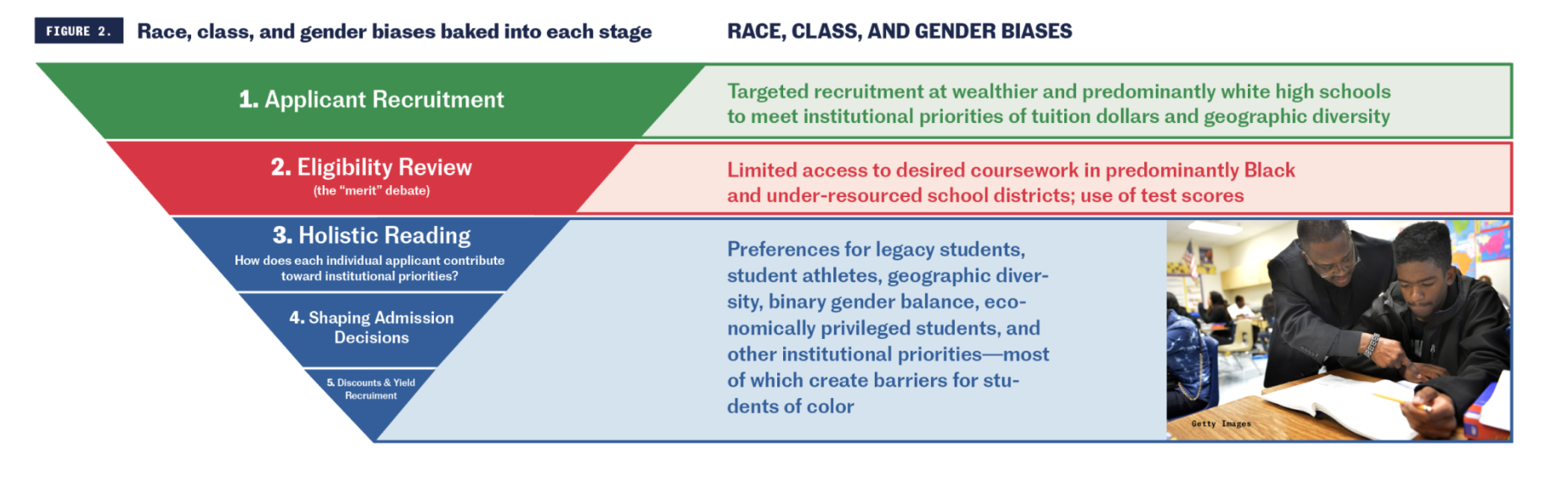
The report provides an excellent history of how we got here and what might otherwise be done. The authors analyze the many legal challenges to admissions decisions over decades. They summarize empirical research on the predictive value of various data points on eventual success in college (few predict success beyond the first year). They draw on primary documents from the institutions themselves to show how these colleges have always preserved the advantages of the white elite who have traditionally attended these schools, even if they do offer admissions to a very select number of students from less privileged backgrounds.
Holistic Review of Applications
The report also provides one of the most detailed analyses of holistic admissions reviews that I have read. In holistic review, reviewers work to determine how each individual applicant contributes toward institutional priorities, reading beyond grades and test scores to glean information about character, unique strengths, or experiences that will contribute to a strong class. Historically, this review favored the children of the wealthy who can gather letters of recommendation from influential people and whose parents can buy them character-building experiences unavailable to most young people. A talented oboist who spent summers at elite performing arts camps may be admitted with test scores below those of other admitted students; a young man who moved in with a dying grandparent during his senior year when no other care was available may be rejected for those same test scores. Yet there's no objective measure by which talent in classical music has a higher potential social value than another student's deep and detailed knowledge of broken social safety nets and the work of investing deeply in the care of others.
Thus, the authors suggest that these admissions reviews could weigh many student qualities and accomplishments that are now overlooked. As another example: we do not have evidence that a privileged student whose parents can send them to do volunteer work in a developing country will contribute more to the campus (and to the public good) after graduation than an applicant whose admissions essay is woven with insightful accounts of socioeconomic inequality in the United States and whose letters of recommendation detail their creative support of children in their own community as they navigate under-resourced schools to become artists and scholars.
Recommendations
The authors recommend admissions systems now used in some states: Guaranteed admission for applicants who are the top students in every public high school; direct admissions in which high achieving students in each state are proactively admitted without cumbersome paperwork. They propose that elite schools recruit much more broadly than the circuit of elite high schools where they now recruit. They argue for more intentional data collection and analysis to challenge unquestioned admissions processes. They argue for advocacy for educating all students within a diverse class in which everyone's perspectives are deepened.
Admissions decisions obviously matter for individuals. Admission to elite schools leads to higher pay over a lifetime, deeper community ties, more investment in public life.
Admissions to elite schools also determine who will have access to the pipeline into leadership positions in the public and private sectors. It is exceedingly difficult to justify admissions decisions that ensure that the children of the white and wealthy will hoard leadership positions in the highest levels of government, law, and business when the current process of admissions has less to do with selecting those students who will best serve the good of the broader society than it does with preserving privilege.
Lani Gaunier's brilliant book The Tyranny of Meritocracy informed much of this report and deserves to be more widely read, especially now with so much public discourse about "fairness" in admissions.


